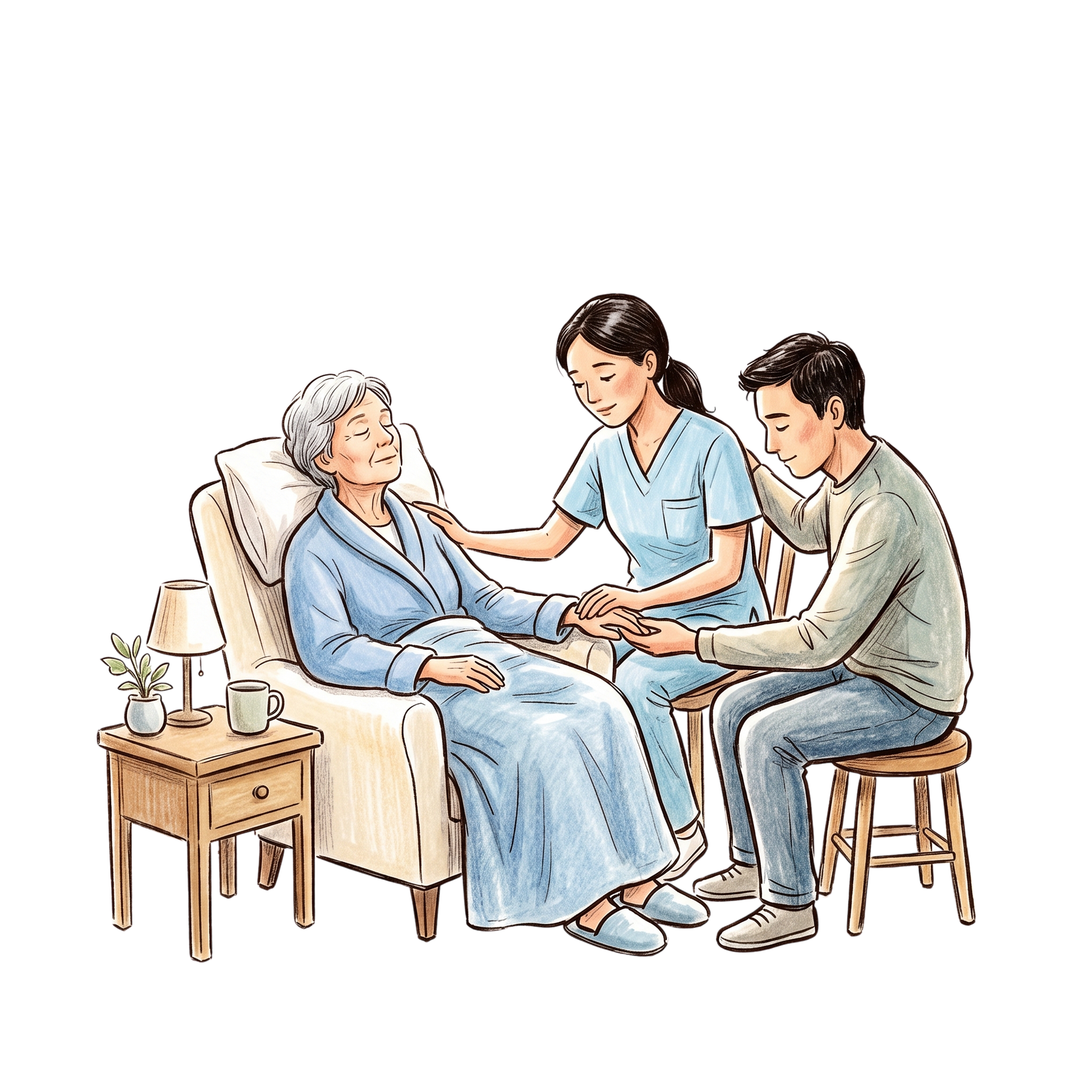
Caregiving means helping others through traumatic times AND learning to let go while retaining your own physical, mental, emotional, and spiritual health.
As First Lady Rosalynn Carter famously observed,
“There are four kinds of people: those who have been caregivers, those who are caregivers, those who will become caregivers, and those who will eventually need care.”

When someone you love is living with a serious or terminal illness, caregiving can gradually become more than something you do. It can become the framework around which your entire life is organized.
Medications must be given. Appointments must be kept. Meals, bathing, transportation, insurance, household responsibilities, and countless unexpected needs have to be managed.
Beyond these practical responsibilities lies another, less visible job: being emotionally present for someone who may be frightened, angry, confused, grieving, or increasingly dependent upon you.
Caregiving can be an extraordinary expression of love. It can also be exhausting. One of the hardest lessons for a devoted caregiver is recognizing that caring for another person does not require abandoning yourself.
Caregiving, in other words, is not an unusual detour from human life. For many of us, it is part of being human. Let’s take a short walk through the three stages of Caring for Them → for Yourself → and Also Learning to Let Go
Caregiving Means Being Present

When someone is seriously ill, the caregiver naturally wants to make things better.
You research. You schedule appointments. You find specialists. You keep track of medications and symptoms. You search for another treatment, another clinical trial, another nutritional approach, another possibility.
That persistence can be invaluable.
But there may eventually come a painful moment when the question changes from: “How can I help this person get well?” to “How can I help this person live as fully and comfortably as possible with the time that remains?”
That change is not failure. It is a different kind of caregiving.
Spiritual teacher Henri Nouwen distinguished between curing and caring. Medicine may not always be able to cure a disease, but human beings can continue to offer care, comfort, dignity, companionship, and love.
- Sometimes caregiving means doing something.
- Sometimes it means sitting beside a bed.
- Sometimes it means listening to the same story again.
- Sometimes it means holding a hand when there are no useful words left to say.
- And sometimes the most meaningful gift we can give another human being is simply the reassurance: You are not alone.
Caregiving Means
Also Caring for Yourself
Caregivers often put themselves last. That can seem noble for a while. Over months or years, however, continual self-neglect can lead to exhaustion, resentment, depression, social isolation, sleep deprivation, and physical illness.
You cannot continually withdraw from an account into which nothing is being deposited.
Define Self-Care
Self-care does not necessarily mean vacations, spa days, or elaborate wellness routines.
For a caregiver, it may mean something much simpler, like:

- Eating a nourishing meal instead of skipping lunch.
- Sleeping while someone else stays with your loved one.
- Walking outside for fifteen minutes or spending even five minutes grounding yourself by walking, standing, or sitting with your bare feet on the ground. (An alternative – especially for city dwellers – is to get a grounding mat for under your feet or grounding bedsheets to lie on with bare or scantily clothed skin.)
- Calling a friend.
- Keeping your own medical and dental appointments.
- Reading, watching, or otherwise learning something unrelated to illness and “must do” tasks.
- Laughing without feeling guilty about it.
- Saying, “I need help” and accepting it.
- Creating a contingency plan so that you (and others) know what to do in emergencies, and have the supplies and instructions already ready.
There may even be moments when self-care means saying no.
Click here for some techniques for relieving stress and calming your mind.
Jack Kornfield wrote, “If your compassion does not include yourself, it is incomplete.”
That principle matters enormously for caregivers. You are not merely the person administering care. You are also a human being living through an extraordinarily demanding experience.
- Your fatigue matters.
- Your grief matters.
- Your frustration matters.
- Your life still matters.
Caring for yourself does not subtract love from the person who is ill. It helps preserve your capacity to continue offering that love.
Caregiving Means
Accepting Your Limits
“We’re all just walking each other home.”

The famous quote by spiritual teacher Ram Dass serves as the title and core theme of his 2018 book with Mirabai Bush, Walking Each Other Home: Conversations on Loving and Dying.
There is another burden caregivers sometimes carry silently: the belief that if they just work harder, research more, stay more vigilant, pray more fervently, or find the right treatment, they can control the outcome.
- Sometimes our efforts do change outcomes.
- Sometimes they cannot.
That distinction can be agonizing.
When an illness progresses despite everyone’s best efforts, caregivers may experience guilt:
- Did I miss something?
- Should I have pushed harder?
- What if we had tried another treatment?
- Could I have done more?
There will almost always be one more thing that could have been done, theoretically. But being human means living with limits to our knowledge, our bodies, our resources, and ultimately our control over life and death.
- Accepting those limits does not mean that you stopped loving.
- It means recognizing that love and control are not the same thing.
Even doctors cannot save everyone! They and you can accompany someone through an experience without having the power to determine its ending. That may be one of caregiving’s hardest lessons.

The truth is that whether someone lives or dies IS NOT UP TO YOU TO DETERMINE. When a person’s soul has done what it came to do on earth, it will leave.
That is true regardless of whether the person is an infant or a person who has lived well into old age.
“Grief is the price we pay for love.” — Queen Elizabeth II
Caregiving Means Learning to Let Go
Anticipatory Grief
“The deeper that sorrow carves into your being, the more joy you can contain.” — Kahlil Gibran
For caregivers accompanying someone through terminal illness, grief often begins long before death.
It may begin when the diagnosis is given. It may deepen when independence disappears, when familiar routines end, when conversations change, or when the person you love can no longer participate in the life you once shared.
This is anticipatory grief: mourning losses that are already occurring while knowing that another loss may be approaching.
Learning to let go does not mean withdrawing love. Quite the opposite.
Sometimes letting go is love stripped of its demand that circumstances be different. It may mean allowing someone to talk about dying instead of immediately reassuring them that they are not going to die.
- It may mean asking, “What are you afraid of?” or “Is there something you still want to do, say, or resolve?”
- It may mean helping family members understand a loved one’s wishes for end of life care, disposition of property, and other decisions.
- And eventually, it may mean giving someone permission to stop fighting when fighting has become suffering.
None of this makes goodbye easy. Love makes loss painful precisely because the relationship mattered.
But perhaps the final task of caregiving is not to prevent death at all costs. Perhaps it is to help another person approach the end of life knowing that they were valued, heard, respected, and loved.
The Caregiver Needs Care Afterward, Too
When caregiving ends, the caregiver’s journey does not.
For months or years, life may have revolved around another person’s needs. Suddenly the appointments stop. The medications disappear. The equipment may be removed. The telephone becomes strangely quiet.
And the caregiver may be left asking: Who am I now?
Grief deserves time. So does recovery. There is no required timetable for either.
The person who has spent months or years caring for another may need to relearn how to sleep, socialize, make plans, pursue interests, or simply experience an ordinary day without being responsible for someone else’s survival. That, too, is part of caregiving.
You cared for them. You learned (perhaps imperfectly) to care for yourself. And finally, you learned the most difficult lesson of all: how to love someone enough to let go. Perhaps that is one of the deepest meanings of caregiving.
We cannot promise one another that the road will be easy. We cannot promise that illness will be cured or that life will unfold according to our wishes. But while we share the road, we can carry a burden. We can offer comfort. We can protect dignity. We can listen. We can rest when we need to. We can ask others to help carry the load. And, for as long as we are able, we can walk beside one another.
Caregiving Means
Caring for them. Caring for ourselves. And, when the time comes, learning to let go.
Comments or Questions? Need to Talk? I’d Be Happy to Help You!

Talk to Nancy Wyatt in a Sip & Share Session!
If you send a question or comment, and the communication should be “just between us,” we can correspond through email (GetWellStayWell@Outlook.com or MyGetWellGuru@gmail.com. Just put “Private Get Well Inquiry” in the subject line. You also should feel free to leave a comment or question in the contact form below. You are welcome to request a Sip & Share Session on Zoom with me.
The first one is FREE and lasts up to 30 minutes while we discuss your needs or project and my services. It is NOT a high-pressure sales pitch. It is an exploration of how we may help each other.
DISCLAIMER: I am not an expert, nor am I certified in any medical or scientific research capacity. I am simply sharing research that I’ve gathered from reliable sources, so that we all may learn and begin our own investigations. Neither I nor this website makes any claims about prevention, diagnosis, treatment, or cure for physical, emotional, mental, or spiritual illnesses or symptoms. This content is for informational and educational purposes and does not provide individual medical advice. Contact your health provider about your situation.
Disclosure re AI Usage: In the interest of transparency, I, the author, Nancy Wyatt, note that I used AI assistance to acquire facts and research links. The author maintains full responsibility for the final content. I affirm that this tool was used as a supplemental resource, not as a replacement for original thought or professional judgment. The content is a composite of words and phrases originating in my mind, along with input from AI.
Self-Care Is the New Health Care
Let’s Get Well, Stay Well, and Live Well!


Author: Nancy (Ayanna) Wyatt, Life Coach & Spiritual Counselor
Nancy (Ayanna) Wyatt, Author, CLC, MHT, TNLP + Reiki Master, Spiritual Counselor, Life Coach, Teacher, Trainer, Writing/Editing, Infographics, Web Content and Blogging Services. She helps people – from all walks of life – see their own beauty so they can heal and thrive, mentally, emotionally, physically, and spiritually.