
Calm Your Mind – Ideas Include Some Surprisingly EASY Steps!
Dear Caregivers,
If you’re reading this between appointments, medication schedules, and the quiet moments when your patient or loved one finally falls asleep, please know this first: what you are doing is sacred work. Caring for someone through illness asks more of your heart, body, and spirit than almost anything else in life.
Somewhere along the way, many caregivers start to feel a pull toward something deeper. They begin a search for meaning, peace, and connection that goes beyond the daily chores. If that’s you, you’re not alone, and you’re exactly where you’re supposed to be.
The good news is that calming your mind doesn’t require hours you don’t have or skills you need to master overnight. Small, gentle practices (that are rooted in both ancient wisdom and modern science) can help you find real relief, even in the middle of chaos. Let’s explore some simple, powerful ways to reclaim your peace.
Calm Your Mind Through the Power of Your Breath
Your breath is the fastest, most accessible tool you have for shifting your nervous system out of “fight or flight” and into rest. When stress builds, your breathing becomes shallow and quick without you even noticing. Reversing that pattern for even for sixty seconds sends a direct signal to your brain that you are safe.
Try this simple technique: breathe in slowly through your nose for a count of four, hold gently for four, and exhale through your mouth for a count of four, and hold your breath again for four counts. Repeat at least 3 times. This is sometimes called “box breathing” or “extended exhale breathing,” and research has shown it can lower cortisol levels and ease anxiety in minutes. You can do this while sitting beside a hospital bed, waiting in a pharmacy line, or lying awake at 3 a.m.
While the core practice of rhythmic, four-part breath holding originates from ancient pranayama yoga (specifically a technique called Sama Vritti), the modern term “box breathing” and its specific tactical application were popularized and adapted by Mark Divine, a retired U.S. Navy SEAL Commander.
He developed the modernized framework to help military personnel manage intense, high-stress combat environments by consciously regulating the autonomic nervous system.
The Science Behind the “Box Breath” Technique
When a person enters a high-stress situation, the body initiates the sympathetic nervous system (“fight or flight”), spiking heart rate, blood pressure, and cortisol. Box breathing deliberately forces the body back into the parasympathetic nervous system (“rest and digest”).
The specific four-part sequence triggers immediate physiological shifts:
-
The Inhale (4 Counts): Deeply expands the lungs, drawing oxygen down into the lower lobes where it stimulates the vagus nerve.
-
The First Hold (4 Counts): Increases carbon dioxide levels in the blood, which relaxes blood vessels and triggers a lower heart rate.
-
The Exhale (4 Counts): Slowly expels air, signaling to the brain that there is no immediate, acute physical threat requiring a panicked escape.
-
The Second Hold (4 Counts): Empties the lungs completely, building a mild tolerance to carbon dioxide and anchoring mental focus tightly to the counting mechanism.
Calm Your Mind by Adding “Energy Work” to the Breathwork
Breathwork is also a beautiful entry point into energy work.
It’s so simple.
As you breathe, imagine drawing in calm, golden light with each inhale.
Then, release all tensions and worry with each exhale.
This isn’t just useless imagination. It’s a practice used across many healing traditions to help the body release what it’s been holding onto. You don’t need any special training to begin. You simply need permission to pause, and that permission starts with you.
Calm Your Mind With Meditation and Gentle Mental Reframing
Meditation has a reputation for being complicated, but at its heart, it’s simply the practice of returning your attention to the present moment, again and again, with kindness.
Even five minutes a day has been shown to reduce symptoms of caregiver stress and improve emotional resilience over time!
You don’t need a silent room or a special cushion. Try sitting quietly and simply noticing five things you can hear, four things you can feel, three things you can see. This brings your mind out of worry about tomorrow and into the safety of right now.
Calm Your Mind with Neuro-linguistic Programming (NLP)
With or Without Hypnotherapy!
Another gentle tool worth exploring is Neuro-Linguistic Programming, or NLP. In simple terms, NLP helps you notice the stories your mind tells you. It might say things like, “I’m not doing enough,” “I’ll never get a break,” or other things that are depressing. With NLP, you learn how to gently rewrite them into something truer and kinder.
- A favorite technique is the “anchor.” You purposely recall a memory when you felt calm and capable. One “anchor” method is to fully allow the associated feelings to fill you mind, body, and emotions. Then, while you’re in that feeling, gently squeeze your thumb and forefinger together. With practice, that same gesture can help call back that calm feeling when you need it most. The are other kinds of anchors that can be used as effectively.
- When combined with hypnotherapy, the results can be astoundingly wonderful. Click here to learn more if you would like for me to help you with either technique.
These practices aren’t about ignoring your pain. They’re about giving your exhausted mind a rest from constant waiting for or attending to the next crisis. They enable healing to happen – yours, and then theirs, because you are in a better frame of mind.
Calm Your Mind by Moving and Restoring Your Body
Movement is medicine, especially for caregivers who spend long hours sitting, lifting, or standing still with worry. Research consistently shows that even light exercise (such as a ten-minute walk, gentle stretching, or slow, mindful movement) lowers stress hormones and lifts mood in ways that last far longer than the activity itself.
If time is scarce, look for movement you can fold into your day: stretch your arms overhead while the kettle boils, do a few shoulder rolls while sitting with your loved one, or step outside for fresh air while a nurse or family member takes over for a few minutes. Sunlight and fresh air alone can help regulate your body’s natural rhythms.
Yoga and ChiGong, among others, offer a wide range of gentle movements that are both calming and help to get the blood, oxygen, and lymph fluids circulating as well as stretching your muscles and fascia.
- Yoga is an ancient practice that connects the mind, body, and breath through physical poses, breathing exercises, and meditation. MedlinePlus (.gov)
- Qigong is an ancient Chinese practice defined as a system of body posture, controlled breathing, and mental concentration used to cultivate life energy. It translates literally to “life energy cultivation” or “qi work.”
Calm Your Mind with Energy Healing, Like Reiki
Many caregivers also find comfort in gentle energy practices like Reiki. This is an energy technique you can learn for yourself, or you can engage a practitioner to give you a session.
There are two basic kinds of sessions. In a full-body session, you are fully-clothed and are lying on a massage table while the practitioner places hands in specific positions across the body. (You may ask to know those positions and ask that some be skipped, if it makes you uncomfortable. But, this is not massage.) These sessions can last for around 45 minutes and include a consultation beforehand and a “debriefing” afterward to see what you experienced. For more information about what to expect in a full body session, click here.
When time is short, the practitioner can give you a “seated Reiki” session, in which you sit on a chair, and the person shares Reiki energy with you in limited positions for from 5 – 15 minutes or so.
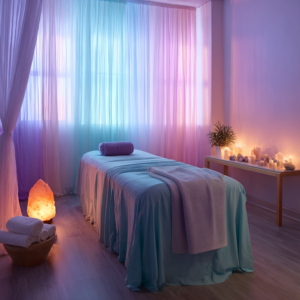
or guided visualization, which combine physical stillness with intentional healing focus. These practices ask nothing of your body but rest, while still offering a felt sense of restoration.
What About Sleep? We Know You Know!
If You Can’t Sleep, You Can Still Calm Your Mind…
You already know you need it, and you already know it’s often the hardest thing to find. Rather than adding pressure to “sleep better,” try releasing the goal of perfect sleep altogether. Or, do what I do. I tell myself, “If you can’t sleep, then just rest.” When I quit TRYING to sleep and just rest, sleep often follows fairly quickly. Even if it doesn’t, I am more relaxed and able to benefit from resting in dark stillness and quietude.
Tip: A short body scan meditation before bed, a warm cup of caffeine-free tea or a small protein snack or drink (like milk or cheese), or simply lying still with your eyes closed for twenty minutes can offer real restorative value, even without full sleep. Rest, in any form, still counts.
Calm Your Mind with Silence and Stillness
There is a quiet kind of medicine in silence. When you allow your body and mind to simply stop – even for a few minutes – your nervous system shifts out of high alert and into a state of rest and repair.
- Physically, blood pressure and heart rate begin to settle, breathing deepens naturally, and muscles that have been quietly bracing all day start to release.
- Mentally, silence gives your overworked mind room to catch up with itself; racing thoughts slow down, and clarity often surfaces in the space where noise used to be.
- Emotionally, stillness creates a safe container to simply feel what’s there (grief, worry, love, exhaustion) without needing to fix or explain it.
- Spiritually, silence is where messages from your soul can finally be heard in your mind. It reminds me of the saying that “Prayer is asking questions. Meditation (silence) is being ready to receive the answers.”
For caregivers especially, even brief moments of true silence can feel like setting down a weight you didn’t realize you were carrying.
Calm Your Mind with Meditation Music
Gentle, intentional music can guide the body and mind toward calm in a slightly different way than silence by giving the nervous system something soothing to entrain to, rather than asking it to sit with nothing at all.
Slow, low-frequency, minimal-instrument music without words can help lower heart rate and slow breathing, ease muscle tension, and quiet the mental chatter, while also creating emotional spaciousness for release and reflection.
Many people gravitate toward music built around specific frequencies believed to support relaxation: 528 Hz is popularly associated with calm and balance, 432 Hz is often described as gentle and “naturally” tuned, and delta-range tones (roughly 0.5–4 Hz, typically layered as binaural beats) are associated with deep rest and sleep, while theta-range tones (4–8 Hz) are often used for meditative, dreamlike states.
It’s worth noting that scientific evidence for these specific frequencies is still limited and mixed. What matters most for most listeners is a slow tempo, simple melodic structure, and an overall soothing tone, whatever the exact frequency label.
A Few Words for You
To the one who holds another’s hand through the night,
Who trades your rest for their needs, your time for their fight,
Your strength is quiet, but moves mountains still.
Your love is a Light that nothing can kill.
May you find, in small moments, the peace you deserve.
You are more than your duties — and we must preserve
YOU!
Caregiving is one of the most selfless acts a person can offer, and it’s also one of the most spiritually awakening. Many caregivers discover, often to their own surprise, that this hard season becomes a doorway to deeper self-understanding and connection. If you’ve felt that pull toward something more … toward meditation, energy healing, or simply a quieter mind … trust it. You don’t have to earn rest. You don’t have to wait for the “right time” to care for yourself, too.
Start small. Choose one practice from this list and try it today. Your mind, your body, and the person you’re caring for will all feel the difference when you are calmer, steadier, and more at peace.
Click here if you want to know “how far along” you are toward reaching “Caregiver Burnout.”
Click here to learn what things MUST be addressed.
Comments or Questions? I’d Be Happy to Help You!

Talk to Nancy Wyatt in a Sip & Share Session!
If you send a question or comment, and the communication should be “just between us,” we can correspond through email (GetWellStayWell@Outlook.com or MyGetWellGuru@gmail.com. Just put “Private Get Well Inquiry” in the subject line. You also should feel free to leave a comment or question in the contact form below. You are welcome to request a Sip & Share Session on Zoom with me. The first one is FREE and lasts up to 30 minutes while we discuss your needs or project and my services. It is NOT a high-pressure sales pitch. It is an exploration of how we may help each other.
DISCLAIMER: I am not an expert, nor am I certified in any medical or scientific research capacity. I am simply sharing research that I’ve gathered from reliable sources, so that we all may learn and begin our own investigations. Neither I nor this website makes any claims about prevention, diagnosis, treatment, or cure for physical, emotional, mental, or spiritual illnesses or symptoms. This content is for informational and educational purposes and does not provide individual medical advice. Contact your health provider about your situation.
Disclosure re AI Usage: In the interest of transparency, I, the author, Nancy Wyatt, note that I used AI assistance to acquire facts and research links. The author maintains full responsibility for the final content. I affirm that this tool was used as a supplemental resource, not as a replacement for original thought or professional judgment. The content is a composite of words and phrases originating in my mind, along with input from AI.
Self-Care Is the New Health Care
Let’s Get Well, Stay Well, and Live Well!

Author: Nancy (Ayanna) Wyatt, Life Coach & Spiritual Counselor
Nancy (Ayanna) Wyatt, Author, CLC, MHT, TNLP + Reiki Master, Spiritual Counselor, Life Coach, Teacher, Trainer, Writing/Editing, Infographics, Web Content and Blogging Services. She helps people – from all walks of life – see their own beauty so they can heal and thrive, mentally, emotionally, physically, and spiritually.